






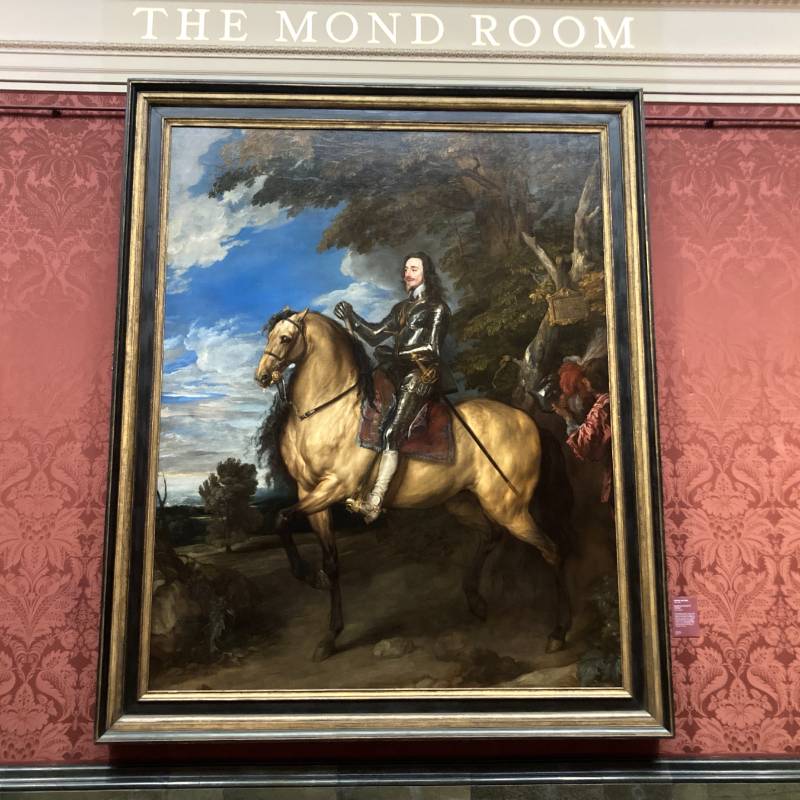
 We cut off the head of King Charles the First with an axe at 2pm on 30 January 1649...
The second largest portrait in the house
is this equestrian portrait of a king
who has no crown, no sceptre, and no orb,
the usual signs of majesty and power,
but just a suit of armour and a sword
and it's only from the notice on the tree
that he identifies himself as Carolus
the Latin name for Charles and Rex Magnae
Britanniae Great Britain's King,
the Language used a provocation in
a country which spoke English and rejected
what was called the mumbojumbo of
the Latin of the Roman Catholic church.
The Magnae meaning Great shows that the Scotland
of Charles' heritage is now included
as a part of Britain and is further
ref'renced by the thistle bottom left.
Not even the Romans had achieved
the subjugation of the hairy tribes
beyond the wall the Emperor Hadrian built.
Indeed, the name Britannia summoned up
the ancient Roman past with Charles the King
as Caesar though this also had the effect
of making him dictatorial when he tried
to rule alone without a parliament.
Van Dyck portrays him in a regal pose
upon his horse, imperious, proud, aloof,
a gold chain round his vulnerable neck
carrying the insignia of the Garter
'gainst his breastplate - dressed for war,
belligerent, contemptuous of The Commons
who'd refused to raise his taxes.
But just as painting's only oil on canvas,
Charles' warring skills were only surface
attributes. He looked good in his steel suit,
but it is all pose and gesture. On
the right, the page in pink is carrying
his helmet to expose his fragile head
with trim, waxed, pointing beard, effeminate
gold earring and eccentric hairstyle, long
on one side only, and reflected in
the horse's mane absurdly. It's ironic
that this head will be held forfeit in
a decade. Charles will lose the Civil War.
(Incidentally the horse's head
has shrunk - or is it that the pale coat
and the musculature is too big,
a mirror of the arrogance and puffed up
self-esteem of royalty...)
CHARLES
I was born in sixteen hundred, second
son of James the Sixth of Scotland who,
when I was three, became the First of England.
My older brother Henry died in twelve.
I married Henrietta, youngest child
of Henri Quatre the King of France and Marie
de Medici. I was absent from the wedding
which took place at Notre Dame in Paris
sixteen twenty-five, the year of my
accession, with a proxy in my place,
a distant relative, the Duc de Chevreuse.
We both had the same great grandma. Chevreuse
even slept with Henrietta but
apart except for one leg touching as
a symbol of the consummation. She
was fifteen. She then came to England and
we met at Canterb'ry. The organist
Orlando Gibbons who was with me died
quite unexpectedly as we were waiting
for her. We were married for a second time
with me now present and we spent our wedding
night nearby. I called her Mary and
named Maryland for her. She wouldn't have
that name and signed herself imperiously
Henrietta R.
I had met her previously on tour
through Europe with the Duke of Buckingham
to meet the Habsburg Princess in Madrid
and maybe marry her. The Habsburg motto:
others make war - we make marriages.
En route I studied art with Buckingham
who was a connoisseur and aesthete.
Embarrassingly Spain rejected me.
I was an infidel and must convert.
A marriage to the Bourbon Henrietta
was a tit for tat against the Habsburgs
as the families were enemies.
Once married I then beautified the court.
I hired impressive painters and musicians
like Van Dyck and Gentileschi and
on hearing the of the Duke of Mantua's
financial hardship bought for England his
entire collection.. Nich'las Lanier
my agent, art aficianado, Master
of the Musicke, fixed with help from Daniel
Nys, a Swedish weapons trader, what's
been called 'the greatest single coup
in the hist'ry of collecting by
a buyer, prince or patron...'
ANTHONY VAN DYCK 15991641
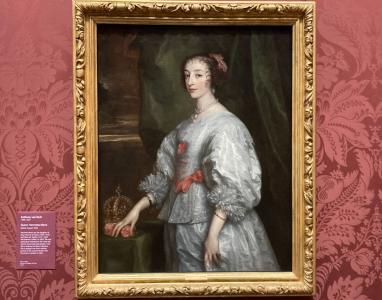
I painted Henrietta (2) shortly after
my return in sixteen thirty-two
to London. I had been here once before
in sixteen twenty when King James had hoped
to make me his court painter but I stayed
just four months. I was only twenty-one
and not yet ready to establish roots
and so continued my apprenticeship
in Italy, returning in the sixteen
thirties after Rubens had gone home.
The King commissioned me to paint his wife
and paid me twenty pounds for it.
Se wears a silver-grey dress with pale pinkish
scarlet bows in contrast to the green cloth
in the background. Long and slender right hand
fingers lightly clasp a pink rose with
a coronet behind. She's twenty-two.
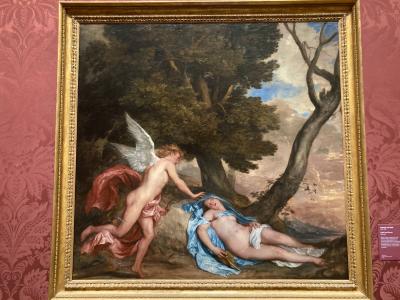
I painted Cupid and the sleeping Psyche (3)
in the last year of my short life sixteen
forty. It's the only painting of
a myth I did for Charles and was commissioned
either for the Queen's House or to mark
the marriage of King Charles' granddaughter
the Princess Mary to her Dutchman husband
William. Psyche is the human soul


 Home
Home Tours
Tours Private booking
 Your guide
 Blog
Blog Contact