





 The Birmingham artist Hurvin Anderson introduces himself...
I was born in Handsworth, Birmingham
in nineteen sixty-five. My parents came here
from Jamaica in the fifties with
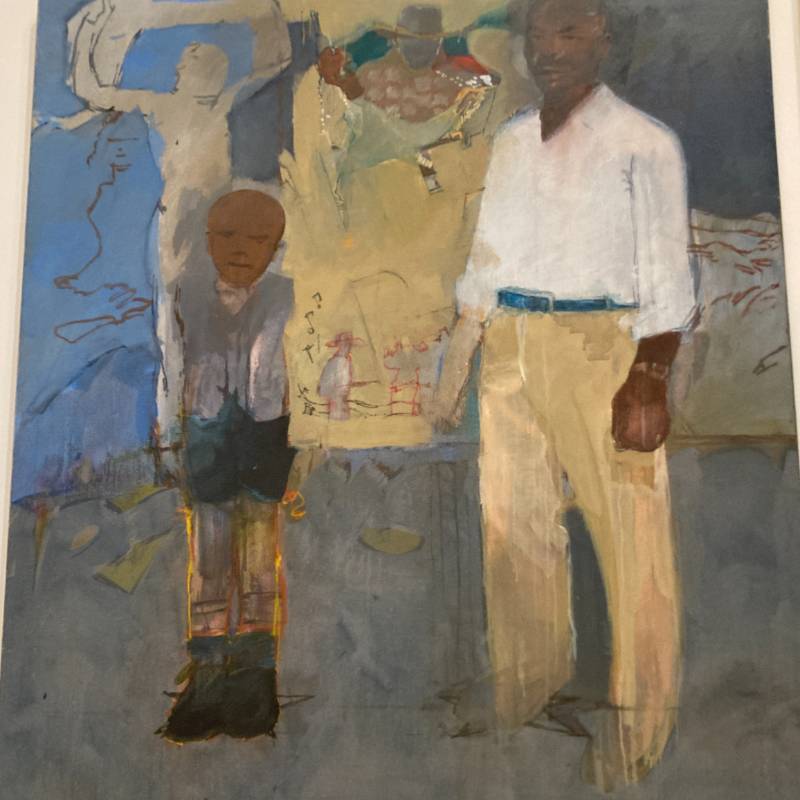
the Windrush generation. That's me with my Dad
outside a pub in Brum. The poster shows
a Negro cowboy which subverts convention.
Westerns featured only pale skin actors.
I decided I could be an artist
which was not the norm with Brummie Blacks.
At Wimbledon I graduated BA
and then MA from the RCA,
art's Royal College where photography
as well as paint became my specialism.
Odd jobs helped me pay the rent. I started
my career with Trinidad and London
residences in two thousand. Photos
altered, mine and others', are my canvases.
They're memories and sometimes hazy which
accounts for the abstractions - trying to grasp
an image through the mists of time. The paint
disrupts the 'truth' of photographs. I sometimes
use just black and white to give a sense
of passing time as in the portrait of
my sister both as faceless girl and woman,
Bev, cross-legged and folded arms. Or in
my monochrome American, a tribute
to photographer Seydou Keita,
the father of the art in Africa
who died aged eight in two thousand one.
That's Mrs Keita in the sixties by
a TV set in patent leather boots,
her floral mini blending with the curtain.
I employed this striking image lots.
Re-use became the hallmark of my work
as memories recur, events repeat.
A visit to the barber's: take a seat, boss,
in this office chair. Short back and sides?
The shelf with lotions, aftershaves and photos
of our jeroes Martin Lther King
and Malcolm X we study with each shearing:
Caribbean scenes are hand-me-downs:
security in grilles and chicken wire,
the latter round the tennis court preventing
entry to the Country Club. I'm good
at trees and show them taking over buildings like my work
Ashanti Blood in twenty twenty-one
in which an evergreen with scarlet flowers
covers up a concrete wall. The name
alludes to those Ashanti slaves killed in
Jamaica in the sev'nteen sixty slave
rebelllion Tacky's War...

 Home
Home Tours
Tours Private booking
 Your guide
 Blog
Blog Contact